

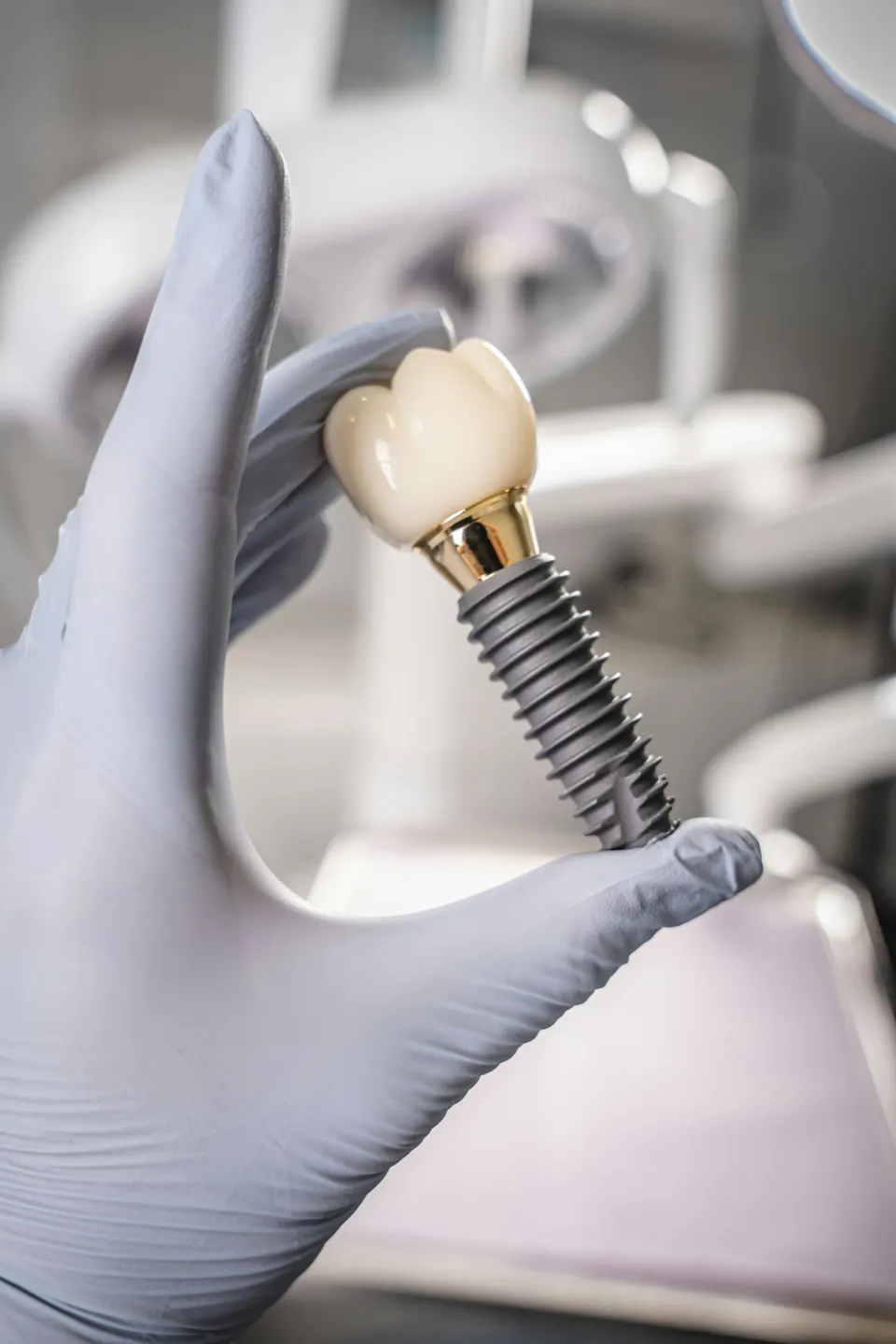
Dental implant treatment is a method of replacing missing teeth by placing artificial roots, usually made of titanium, into the jawbone and attaching fixed teeth to them. No treatment fully replaces a natural tooth, but when the options are weighed up, implants have become one of the most important alternatives for people who have lost teeth. For patients planning dental treatment in Turkey, implant therapy at our clinic in Denizli, Turkey begins with a medical history, clinical examination and 3D CT assessment, and the plan is shaped around both your expectations and the dentist's recommendations.
- Missing teeth can be replaced without cutting down healthy neighbouring teeth for a bridge
- A fixed alternative to removable dentures, or a way to stabilise an existing denture
- Implant length, width and position are planned from CT measurements of the bone
- In suitable cases, an implant can be placed and loaded on the day of extraction
Treatment process
Examination and CT scan
Your medical history is taken and the mouth is assessed clinically, radiographically and with a CT scan. Any need for bone grafting usually becomes clear at this stage.
Treatment plan
The number and size of implants and the type of restoration are planned together, based on your wishes and the dentist's advice.
Implant placement
The implant is placed into the jawbone under local anaesthesia. Where bone volume is sufficient, a single implant takes around 5–15 minutes.
Healing and integration
Much like a broken bone knitting together, the implant fuses with the jawbone (osseointegration). This usually takes 2–4 months.
Crown or prosthesis
Once integration is complete, impressions are taken and the crown, bridge or implant-supported denture is fitted.
Check-ups and care
Regular brushing, cleaning between teeth and periodic check-ups help keep implants healthy for the long term.
What is a dental implant and who is it for?
A dental implant is an artificial tooth root, usually made of titanium, placed where a tooth is missing. It allows fixed teeth to be restored for people who have lost teeth for any reason.
Implants are often chosen by patients who:
- Do not want healthy neighbouring teeth reduced to support a bridge
- Prefer not to wear a partial (metal-framed) or full removable denture
- Find that their full denture moves or does not stay in place; in these cases the denture can be secured on implants
The key requirement is that jaw growth is complete. For adults in good general health there is no upper age limit; the deciding factor is having enough bone height and width to support the implant.
How is implant treatment carried out and how long does it take?
When bone thickness and height are sufficient, placing a single implant takes around 5–15 minutes. After one or two implants, most patients take painkillers only on the first day, and some say they need none at all. Antibiotics may be prescribed in certain cases.
After placement, osseointegration begins: the implant gradually fuses with the bone until it becomes firmly anchored.
- Crowns and prostheses are usually fitted 2–4 months after surgery.
- With some modern implant surface technologies, this period can be shortened to 2–4 weeks.
- Where bone grafting is required, healing can take up to 12 months.
Same-day implants: immediate placement and immediate loading
In suitable cases, an implant can be placed in the same appointment as the tooth extraction (immediate implant). Sometimes the crown work can also begin straight after the implant is placed (immediate loading), so the implant and a crown can be completed on the same day.
This requires the implant to be firmly held in the bone from the outset (primary stability). Stability is measured with an OSSTELL device, which records the implant's vibration frequency in the bone; immediate loading is planned only when the reading is adequate. The decision is made for each patient individually after examination and measurement.
When bone is insufficient: bone grafting
If the jawbone is not thick or tall enough for an implant, a bone graft is used to increase bone volume. Depending on the existing bone, grafting may be carried out before implant placement or during the same procedure.
- The patient's own bone (autogenous graft)
- Grafts of human or animal origin
- Synthetic graft materials
The need for grafting is usually identified during the clinical, radiographic and CT assessment. Shorter implants with more pronounced threads are also available today to reduce the need for grafting where bone volume is limited.
How long do dental implants last?
With accurate diagnosis, careful placement, good oral hygiene and regular check-ups, implants are expected to last for many years and often for life. Some implants placed with technology from 35–40 years ago are still functioning today.
Like natural teeth, an implant's lifespan depends on care: people who neglect their teeth can lose implants in the same way they can lose their own teeth.
Implant brand and implant passport
There are a great many implant brands worldwide. Because an implant is intended to stay in the mouth for decades, it makes sense to choose an established manufacturer that can still supply parts and support if a complication such as a loose or broken screw occurs. Ask your dentist about the brand used and request an implant passport showing the implant's diameter, length and lot number, which is especially useful if you will be having follow-up care in your home country.
When may implants be postponed or unsuitable?
The most important factors for success are careful patient selection, general health and adequate bone quantity and quality. Implant surgery may be postponed, planned together with your physician or considered unsuitable in the following situations:
- Long-term corticosteroid use
- Untreated heart and circulatory conditions
- Titanium allergy
- Autoimmune diseases
- Ongoing cancer treatment
- Liver failure or chronic kidney failure
Please share your full medical history and any medications with your dentist before treatment so that it can be planned safely.
Aftercare following implant surgery
- If a gauze pack has been placed, keep it in for about 1 hour or as advised.
- Do not eat or drink until the numbness has worn off, and avoid rinsing and spitting.
- For the first few days, avoid small hard foods such as seeds and grains; choose soft, lukewarm food.
- If you smoke, stop for at least one week.
- Apply a cold compress where and for as long as your dentist recommends.
- Take prescribed medication regularly, do not take other medicines without informing your dentist, and tell them about anything else you are taking.
- Do not brush on the day of surgery; from the next day, continue brushing regularly. Use an antiseptic mouthwash if advised.
- Stitches are usually removed after one week or when your dentist advises.
- Contact your dentist if anything unexpected happens.
Frequently asked questions
Will I feel pain during implant placement?
The procedure is carried out under local anaesthesia, so pain is not expected during treatment. After one or two implants, most patients need painkillers only on the first day. Recovery varies from person to person.
Is there an age limit for dental implants?
Jaw growth must be complete. For adults in good general health there is no upper age limit; bone volume and overall health are what matter.
How soon are the new teeth fitted?
Usually 2–4 months after placement, once the implant has integrated with the bone. Some implant surfaces allow shorter times, while grafted cases may take up to 12 months. In suitable cases a temporary tooth can be fitted on the same day.
How many visits will I need as an international patient?
Implant treatment normally involves at least two stages: placement, then fitting of the final teeth after healing, usually 2–4 months later. The exact schedule depends on your bone and the plan agreed after your CT assessment.
What if I do not have enough bone?
In many cases bone volume can be increased with grafting, or shorter implants may be used. The most suitable approach is decided after a CT assessment.
What is an implant passport?
It is a record of your implant's brand, diameter, length and lot number. It helps any dentist you see in future identify the correct parts for maintenance or repair.
My lower denture won't stay in place and clicks when I eat. What should I do?
Looseness is common with lower full dentures. In patients who lost their teeth many years ago, bone loss is greater, so even a new denture may not stay in place well. In such cases, placing at least two implants in the lower jaw and anchoring the denture to them is usually the most suitable solution. Suitability is determined by your medical history and a CBCT assessment.
Can dental implants cause cancer?
There is no scientifically proven evidence that implants cause cancer. Inflammation around an implant (peri-implantitis) can develop because of misdiagnosis, incorrect placement or inadequate oral hygiene. That is why careful planning and regular maintenance matter.
Is implant treatment very expensive?
Implant treatment may seem more costly than other options, but in suitable cases it can offer a healthier, longer-lasting solution. What patients mention most is often not the cost but the waiting time between placing the implant and fitting the final teeth. With newer systems, this time can be shortened in suitable cases. Your treatment plan and its scope are determined individually after an examination and a CBCT scan.
Who is suitable for dental implants?
Implant treatment can be carried out for anyone whose jaw bone has finished growing and who meets the necessary conditions. The main conditions are sufficient bone volume and suitable general health. Suitability is assessed through an examination and a CBCT scan.
The information on this website is for general information only and does not replace an examination, diagnosis or treatment plan by a dentist. Treatment and outcomes vary from person to person.