

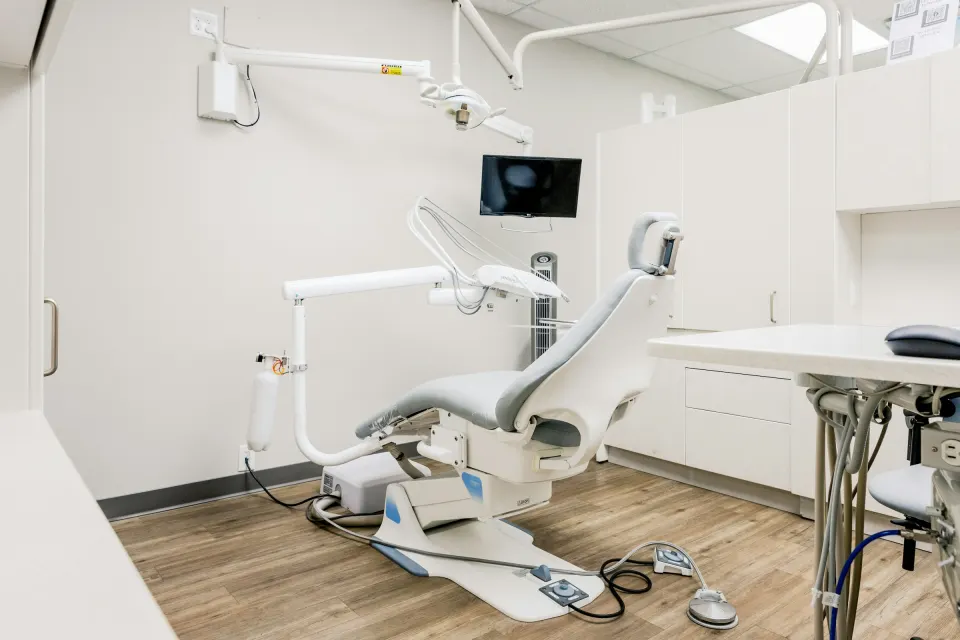
Prosthetic dentistry is the replacement of missing or badly damaged teeth with crowns, bridges or removable dentures. Prostheses fall into two groups: fixed restorations, which the patient cannot remove, and removable dentures, which can be taken out. At our clinic in Denizli, Turkey, the type of prosthesis and the material are chosen by weighing up the condition of the teeth, aesthetic expectations and biting forces together.
- A crown for a single tooth, a bridge for missing teeth
- Metal-ceramic, zirconia-based and metal-free glass-ceramic options
- A shoulder preparation for a precise fit at the gumline
- Complete and partial dentures, with implant-retained options for the lower jaw
Treatment process
Examination and planning
The teeth, gums and bone are assessed, and a fixed or removable prosthesis and suitable material are chosen together.
Tooth preparation
Teeth receiving a crown or bridge are shaped with a defined margin (shoulder) around them.
Impressions
A digital or conventional impression is taken, and the framework is designed and produced with CAD/CAM technology.
Try-in
The fit, shade and bite of the prosthesis are checked in the mouth and any adjustments are made.
Cementation and review
The prosthesis is cemented with an adhesive suited to the material, care advice is given and a review appointment is planned.
Fixed and removable prosthetics
Fixed prostheses are cemented to the teeth with special adhesives and cannot be removed by the patient. Removable dentures are made for patients who have lost many or all of their teeth and for whom fixed work is not possible.
- Crown: a fixed restoration for a single tooth.
- Bridge: a fixed restoration for missing teeth, made of joined crowns supported by the neighbouring teeth.
The main types of fixed prosthesis are:
- Metal-ceramic (porcelain-fused-to-metal) crowns and bridges
- Zirconia-based ceramic crowns and bridges
- Metal-free glass-ceramic crowns
- Porcelain veneers (laminates)
Tooth preparation and fit at the gumline
Preparation is the shaping of a tooth to receive a crown or bridge. With a shoulder preparation, a defined step is created around the tooth, which helps the restoration fit the tooth and gum tissues more closely.
What matters is not whether the margin of the restoration sits below, at or above the gumline, but that it is smooth and fits precisely wherever it is. Hiding a poorly fitting margin under the gum is not acceptable practice. Restorations that impinge on the gum or leave a ledge can, over time, lead to:
- Bleeding gums when brushing
- Bad breath and discoloured gums
- Gum recession
- Decay beneath the crown (secondary caries)
- Bone loss
A poor fit is one of the most common reasons for bleeding gums around crowns and bridges. Mouthwashes or special toothpastes will not resolve it; the restoration usually needs to be removed, the gums treated if necessary, and a new restoration made on a proper preparation.
Metal-ceramic crowns and bridges
Metal-ceramic systems have been used for many years and are clinically well proven. The bond between metal and porcelain is strong. Although zirconia withstands high forces, it does not flex, so for very long bridges metal-ceramic can still be the first choice.
Because the metal framework does not let light through, it can limit aesthetics, particularly at the front of the mouth, and where the gum is thin a dark line may be visible at the crown margin.
Cast versus laser-sintered frameworks
With conventional casting, distortion of the wax pattern and shrinkage caused by temperature changes during casting can compromise the fit. With laser sintering (CAD/CAM), the framework is produced entirely by computer technology, the fit is more precise, and a biocompatible cobalt-chromium alloy is used.
Our clinic does not make cast-metal prostheses; when a metal-ceramic restoration is needed, the laser-sintering method is used for its accuracy and tissue compatibility.
Zirconia-based crowns and bridges
Zirconia is impact-resistant, light, does not conduct heat and transmits light to some degree, so it can replace the metal beneath porcelain. As it is produced with CAD/CAM, the fit is very good when careful impressions and a proper shoulder preparation are made. It costs more than metal-ceramic.
However, fracture (chipping) of the porcelain layered on zirconia is more likely than with metal-ceramic. Zirconia is not the most aesthetic choice in every situation; it can be preferred for long bridges that include front teeth. For single front teeth and short bridges, metal-free glass-ceramic crowns give a more natural look.
Zirconia as a framework
The zirconia is made as a thin framework covering the tooth and is then layered with porcelain, so the zirconia itself is not visible in the mouth.
Monolithic zirconia
With more translucent zirconia blocks, monolithic crowns that need no porcelain layer, and bridges of up to 4–5 units in the back of the mouth, can be made. Because their aesthetics are limited, they suit back teeth where appearance is less critical, and since they can be produced quickly with CAD/CAM they can be a preferred option for back bridges. See our Zirconia page for more detail.
Metal-free glass-ceramic crowns (Empress and e.max)
All-ceramic crowns without metal or zirconia have light transmission and colour very close to natural enamel, so they give a natural appearance, especially at the front of the mouth.
Because they are translucent, the colour of the underlying tooth affects the result; they may not be suitable for discoloured, root-filled teeth, for example. Preparation, try-in and bonding are more demanding than with metal- or zirconia-based crowns and require special adhesive cements. Good oral hygiene is important for patients choosing these crowns.
Empress
An aesthetic ceramic containing no metal or zirconia, preferred for front teeth, particularly where biting load is low. It can only be used for single crowns and is not suitable for bridges.
e.max
Developed to be stronger than Empress. It can be used for single crowns in higher-load aesthetic areas and on back teeth, and for short three-unit bridges replacing a single missing front tooth. The risk of fracture increases in longer bridges, and it should be used with caution in patients who clench or grind (bruxism). See our e.max page for more detail.
Porcelain veneers (laminates)
Porcelain veneers are very thin ceramic shells bonded with strong adhesive systems to the front surface of the teeth, after minimal reduction of that surface or, in some cases, none at all. They are made from Empress or e.max ceramic.
For patients unhappy with the colour or shape of their teeth, a key advantage is that the other surfaces of the tooth are left untouched. A good result requires thorough planning beforehand.
Veneers can also be made from composite, but composite is affected sooner by tea, coffee and smoking, so porcelain is generally considered the better option. Ceramic keeps its colour for a long time. See our Veneers page for more detail.
Removable dentures
Complete dentures
Complete (full) dentures are used when no natural teeth remain. Many patients with a lower complete denture struggle with retention and stability. Placing 2 or 4 implants in the lower jaw can markedly improve retention and stability, considerably reducing problems such as sore spots, food getting underneath and the denture moving. Upper complete dentures usually do not need implant support.
Partial dentures
Partial dentures come in clasp-retained (conventional), precision-attachment and hybrid designs. Each has different advantages and drawbacks in terms of aesthetics, durability and cost, and the most suitable type is chosen according to the patient’s mouth and remaining teeth.
Frequently asked questions
How do I choose between zirconia, metal-ceramic and e.max?
The choice depends on the position of the tooth, the length of the bridge, your aesthetic expectations and your biting forces. Glass-ceramic often suits single front teeth, monolithic zirconia back bridges, and metal-ceramic very long bridges. The decision is made together at your examination.
Why do my gums bleed around my crown?
A common cause is a crown margin that does not fit the tooth precisely or presses into the gum. Mouthwash or toothpaste will not fix this; the crown may need to be removed, the gum treated if necessary, and a new crown made on a proper preparation.
My lower denture keeps moving. What can be done?
Poor retention is common with lower complete dentures. Two or four implants placed in the lower jaw can markedly improve retention and stability. Suitability is assessed at an examination, including an evaluation of the bone.
Do my teeth need to be cut down for veneers?
For porcelain veneers, only a minimal amount of the front surface of the tooth is reduced, and in some cases none at all. The other surfaces of the tooth are preserved.
What is a precision-attachment denture?
It is a partial denture held in place by special attachments connected to crowns on the remaining teeth, rather than by visible metal clasps. Whether it is suitable depends on the condition of the remaining teeth.
The information on this website is for general information only and does not replace an examination, diagnosis or treatment plan by a dentist. Treatment and outcomes vary from person to person.